

89K AI citations in three months
184→2,500
Per day, July to August
42,092
Citations for a single guide
94%
Share earned by four guides
How a new research site became a source that AI answers cite, measured with first-party data from Bing and Cloudflare. The crawler data and code are open.
Open the data and codeCase Study: 89,000 AI Citations in a New Site's First Three Months
TL;DR: ismybrandinai.com launched in June 2026. In the 91 days to 7 September, Bing counted about 89,000 citations of the site in AI answers from Microsoft Copilot and its partners. Four guides earned 94% of them, and one guide alone earned 42,092. Citations averaged 184 a day in July and about 2,500 a day in August. In one week in September, verified crawlers from OpenAI, Google, Microsoft, Anthropic, Meta, Amazon and Apple fetched the site.
ismybrandinai.com is a research site about how AI answer engines choose their sources. It went live in June 2026. This case study shows what happened in its first three months, using first-party data: Bing Webmaster Tools' AI Performance report, which counts how often AI answers cite a site's pages, and Cloudflare's verification of which crawlers really fetched the site.
AI Visibility
- How often did AI answers cite the site?
- Which pages earned the citations?
- What were the AI answers about?
- What did we change before citations took off?
- Which AI companies read the site?
- Can server logs measure AI visibility?
- Are all the AI crawlers in your logs real?
- How we measured
- Data and code
- What this case study shows
How often did AI answers cite the site?
Bing counts about 89,000 citations between 9 June and 7 September 2026. Each citation is one time an AI answer showed one of the site's pages as a source. The report covers Microsoft Copilot, AI-generated summaries in Bing and select partner integrations, under the source label "Microsoft Copilots and Partners". The first citation came on 20 June.
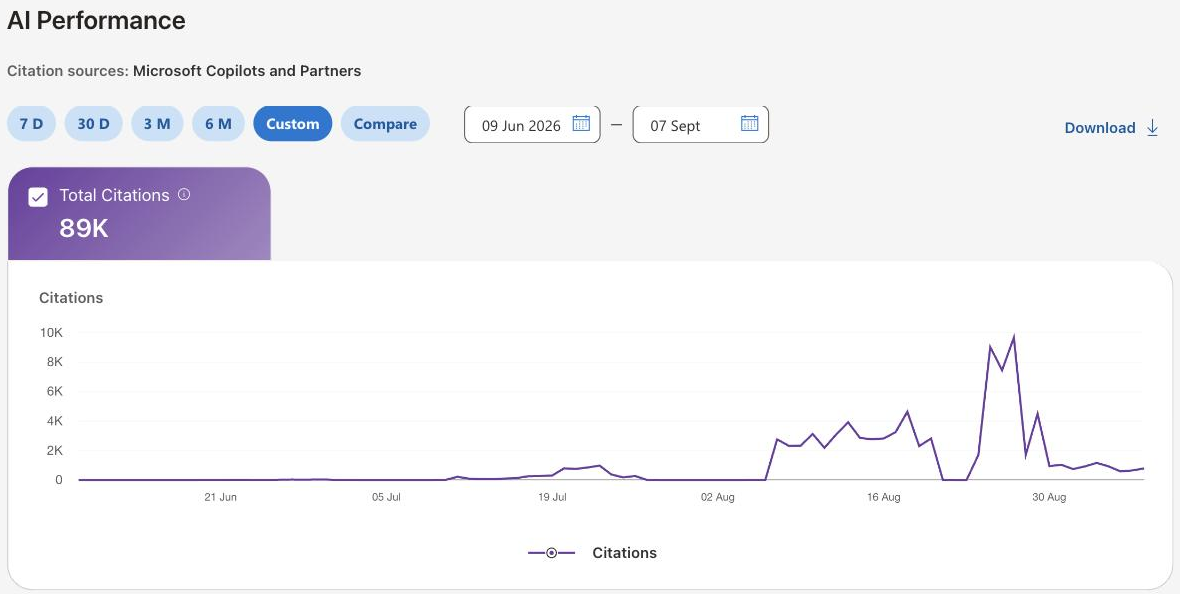
| Period | AI citations | Per day |
|---|---|---|
| 9 to 30 June | 180 | 8 |
| July | 5,715 | 184 |
| August | about 77,200 | about 2,500 |
| 1 to 7 September | about 5,800 | about 830 |
The daily average rose more than thirteenfold from July to August. The first week of September ran at about 830 a day, four and a half times the July pace. The busiest day was 27 August, with about 9,700 citations.
Which pages earned the citations?
| Page | AI citations |
|---|---|
| How to Improve Brand Visibility in AI Search Engines | 42,092 |
| Best AI Citation Tracking Tools | 16,718 |
| Best AI Search Visibility Tools | 12,428 |
| Best GEO Tools | 12,404 |
Together these four earned 83,642 citations, 94% of the total. The winners are a strategy guide and three comparisons that name products, prices and trade-offs. The guide on improving brand visibility in AI search earned nearly half of everything on its own.
What were the AI answers about?
Bing groups the citations under short, generalized phrases that summarize what the AI answers were about. These five brought the site the most citations:
| Phrase, as Bing groups it | AI citations |
|---|---|
| improve brand visibility in answer engines | 9,274 |
| improve brand AI visibility ChatGPT Perplexity Gemini | 7,979 |
| generative AI citation analytics platforms comparison | 3,755 |
| improve brand visibility AI inference results | 3,029 |
| optimize B2B brand AI search engine visibility | 2,570 |
Together they cover the two subjects the site was written for: how brands are seen in AI answers, and which tools measure it.
What did we change before citations took off?
In the first week of August we worked on the four guides that now earn most of the citations. Each change went live the same day:
- 2 August: an editorial review of fourteen guides, including the brand visibility guide and the citation tracking comparison, with new links between related guides.
- 4 August: across the six tool comparisons, six vendors' pricing was checked against each vendor's own pricing page and shown with the date of the check. The AI visibility tools comparison gained two new sections, and three of its headings now ask the questions buyers ask, such as "How much do AI visibility tools cost?"
- 6 August: on the AI visibility tools comparison, the pricing note now sits in its own box, apart from the summary at the top.
On 7 August, the day after the last of these changes, Bing counted 2,800 citations, almost three times the best day in July. Citations stayed above 2,000 on every day from 7 to 20 August.
Bing's report is built for this kind of before-and-after reading, and its documentation notes that trends "cannot be attributed to a specific cause or event", so we present this as a timeline. What it does show is where the effort went: facts checked at their source, vendor prices with a check date, headings that ask the buyer's question, and a clean layout. These are the practices Bing recommends in its own AI Performance documentation: descriptive headings, claims supported by evidence, and content kept fresh and accurate.
Which AI companies read the site?
Cloudflare checks whether a crawler really comes from the company it names. In one week, 3 to 9 September, it verified these companies' crawlers fetching the site:
| Company | Crawlers | Verified requests |
|---|---|---|
| OpenAI | ChatGPT-User, OAI-SearchBot, GPTBot | 396 |
| Meta | Meta-ExternalAgent | 314 |
| Microsoft | BingBot | 168 |
| Amazon | Amazonbot | 142 |
| Googlebot | 136 | |
| Anthropic | ClaudeBot | 49 |
| Baidu | Baiduspider | 42 |
| Apple | Applebot | 35 |
BingBot, Googlebot and Baiduspider are search crawlers. They belong in the table because AI answers such as Microsoft Copilot's and Google's AI Overviews draw on the indexes that search crawlers build (Google, Microsoft). The OpenAI figure includes 240 requests from ChatGPT-User, which ChatGPT uses when someone asks it a question and it visits a page to answer.
Can server logs measure AI visibility?
Not on their own. Crawler requests and citations measure different things. In the five days both sources cover, 3 to 7 September, Microsoft's verified crawlers made 113 requests to the site, while Bing counted about 4,150 citations: 37 citations for every request. Citations outnumbered requests on each of the five days, by 12 to 216 times. A log shows the crawl. The citation happens inside the AI answer, where the site's own log cannot see it. More on how Copilot works in our guide to ranking on Copilot.
Are all the AI crawlers in your logs real?
No. A log records whatever name a request gives, and a name costs nothing to type. Checking a week of requests against Cloudflare's verification drew a clear line.
The real crawlers never asked for a hidden file. Not one of the 3,234 verified requests from AI and search crawlers to this site and to vouchaitools.com, a second site we run, asked for one.
Hundreds of requests that borrowed their names went straight for them. That week, 476 unverified requests
to this site carrying 13 crawler names, among them GPTBot, ClaudeBot and ChatGPT-User, asked for
hidden files: environment files, cloud credentials such as /.aws/credentials, and the credential
and config files of AI coding tools, such as /.claude/.credentials.json and /.cursor/config.json.
That is why the company table above counts verified requests only. Counting AI crawlers by name counts the impostors too.
How we measured
Bing. The AI Performance report in Bing Webmaster Tools for ismybrandinai.com, read on 9 September 2026: the 91-day total, the daily series, the page view and the grouped phrases. The report displays daily values of 1,000 or more rounded to the hundred, and we use them as displayed. Page and phrase figures come from the report's own export. Bing describes the data as a sample of overall citation activity, designed for trend analysis rather than precise accounting.
Cloudflare. The GraphQL Analytics API, dataset httpRequestsAdaptiveGroups, for 3 to 9 September
2026, read on 10 September. We track 20 AI and search crawler names. A request counts as verified
when Cloudflare places it in a verified bot category. A request counts as asking for a hidden file
when its path has a segment that starts with a dot, other than the public /.well-known/, or matches
a short list of well-known secret files.
Changes to the site. Dates and descriptions come from the site's version history.
Data and code
The crawler figures are published as The AI Crawler Identity Report, round one, with their data and
code under CC BY 4.0. Run python3 analyze.py in the folder and it rebuilds the tables exactly.
| File | What it is |
|---|---|
| ai-crawler-identity-round1.zip | Everything below in one download |
| claimed-identity-vs-cloudflare-verification.csv | Per site and crawler name: verified requests, unverified ones, and how many of each asked for a hidden file |
| daily-ai-named-requests.csv | Per site and day: crawler requests by name, verified, and hidden-file attempts |
| secret-file-probe-targets.csv | Per site: what the hidden-file attempts asked for |
| bing-citations-vs-microsoft-requests.csv | Per day, 3 to 7 September: Bing AI citations and Microsoft's verified crawler requests |
| rules.py and analyze.py | The classification rules and the script that builds every crawler table |
| README.md | How to run it |
What this case study shows
A site that went live in June became, within three months, a source that Microsoft Copilot and its partners cited about 89,000 times. Four guides (a strategy guide and three tool comparisons) earned 94% of those citations, and the steep climb began the day after a week of editorial work on those guides. In a single week, verified crawlers from OpenAI, Google, Microsoft, Anthropic, Meta, Amazon and Apple read the site.
A server log shows the crawl, under whatever name each request gives. Bing's citation report shows the citations, and Cloudflare's verification shows which crawlers are real. That is the whole case: a new site, four guides that answer practical questions about AI visibility, and about 89,000 AI citations in its first three months.