

NewOpen dataset · Release 1
What AI tells the world about Türkiye's brands
What six AI engines say about 20 brands, checked fact by fact against the companies' official sources.
Is ChatGPT Accurate About Brands? 97.4% Right, and in 2 of 3 Traceable AI Errors a Cited Page Had the Same Wrong Fact
In short: We checked 20 brands, 11 from Türkiye, across six AI engines. ChatGPT got 97.4% of basic brand facts right, but 16 of its 19 traced errors came from answers with no link to check. In two thirds of the round-one errors we could trace to a readable cited page (110 of 164), that page stated the same wrong value, so correcting those pages looks like the most direct lever; the re-test will show whether it works.
What AI tells the world about Türkiye's brands
- Key findings
- Where do AI engines get wrong brand facts? Often from the pages they cite
- AI brand visibility for Turkish brands: who gets named in English and in Turkish?
- How accurate are AI engines about Turkish brands?
- How accurate is ChatGPT about companies? 97.4% of facts, few links
- Are AI answers accurate for real brand searches like "who owns pegasus airlines"?
- How to fix wrong AI answers about your brand
- How did we measure AI accuracy about brands?
- Does Bing Copilot always give an AI answer?
- Is AI accurate about Alanya? 88% of tourist facts correct
- Are the results stable across runs?
- How to audit AI answers for brand accuracy: the method
- What do these results cover?
- How was this study run on EVREN, Türkiye's public AI infrastructure?
- Report materials
- Data and code
- Compute and independence
- How to cite this
- What is the next measurement after the Turkish brands study?
Key findings
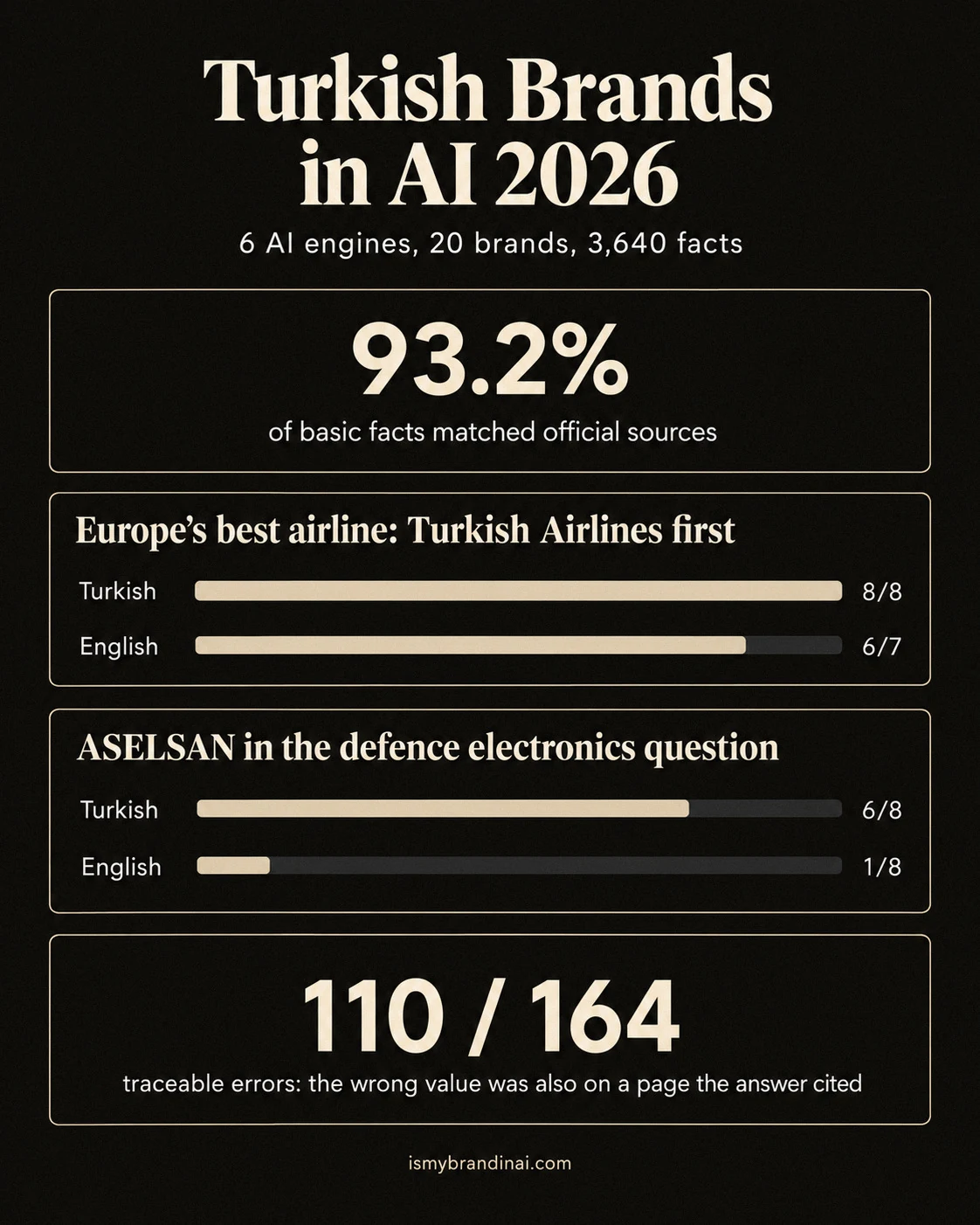
- 67% of traceable errors were already on a page the answer cited. In 110 of 164 round-one wrong or partly wrong claims that could be checked against readable cited pages, a cited page stated the same wrong value. Wikipedia carried 64 of them and news sites 33. (see where the errors come from)
- ChatGPT got 97.4% of basic brand facts right, but most of its errors cited nothing. 662 of 680 checkable claims matched the official source; 16 of its 19 traced errors came from answers with no link. (see the ChatGPT results)
- Turkish Airlines was named first for "best airline in Europe" in 6 of 7 English and 8 of 8 Turkish answers from four engines. It appeared in all 31 answers to the two full-service airline questions. Across both languages that is 14 of 15 answers; at this size the gap between English and Turkish is not a meaningful difference. (see the language comparison)
- ASELSAN appeared in 1 of 8 English answers on Europe's leading defence electronics companies. Asked the same question in Turkish, the four engines named it in 6 of 8 answers. Each language had 8 answers, so this is a small sample. (see the language comparison)
- The basic facts are already right: 93.2%. Of 3,640 checkable claims about founding year, headquarters, owner, countries and size, 3,391 matched the official source. (see accuracy by engine)
- Brands from Türkiye were described correctly 94.3% of the time. That is 1,893 of 2,007 checkable claims, slightly above the European control brands. (see the comparison with European brands)
- Asked the way people actually search, the engines were right 92.1% of the time. On real search questions such as "who owns pegasus airlines", 930 of 1,010 checkable claims matched the official source. (see the real-search results)
- Bing showed no AI answer in 11.8% of captures. In 79 of 669 Bing Copilot captures, Bing returned its ordinary web results page instead of a Copilot answer. (see the Bing captures)
- Asked twice at different times, the engines scored within 0.1 points. The first run gave 1,849 correct of 1,986 checkable claims (93.1%) and the second 1,542 of 1,654 (93.2%). (see the two runs)
Where do AI engines get wrong brand facts? Often from the pages they cite
Often from the pages they cite. For every wrong or partly wrong claim in round one we fetched the pages the same answer cited and checked whether they state the wrong value.
In 110 of 164 traceable error claims (67%), a page the answer cited stated the same wrong value. In only 29 (18%) did the cited pages give only the true value, which may point to the model itself. For comparison, 71 of 80 correct claims (89%) were supported by a cited page; the gap between the two rates is statistically significant (Fisher's exact test, p < 0.001). This is consistent with engines repeating what they read, including what is wrong. A matching value on a cited page shows the wrong fact was in front of the engine; it does not prove the answer was taken from that page, because the same value can also come from what the model learned in training.
ChatGPT's errors are a different case: 16 of its 19 traced error claims (84%) came from answers that cited no link at all, so those errors could not be traced to any page.
- A cited page states the same wrong value
- Cited pages give only the true value
- The cited pages lack this fact, or could not be read
- The answer cited no links
- Bing Copilot 78 claims73%15%12%
- Google AI Overviews 49 claims65%18%16%
- Gemini 30 claims27%13%57%
- Claude 25 claims48%20%12%12%
- ChatGPT 19 claims11%84%
- All engines 204 claims54%14%12%18%
- Correct claims (control) 100 claims71%13%
Perplexity had 3 traced error claims and is not shown on its own; they are in the all-engines bar. Bing captures that showed no AI answer are left out. Correct claims (control): a cited page supports the value; 71 of the 80 control claims with a readable cited page (89%) were supported.
| Page type | Errors (of 110) |
|---|---|
| Wikipedia | 64 (58%) |
| News sites | 33 (30%) |
| Blog and SEO sites | 19 (17%) |
| The brand's own pages | 14 (13%) |
| Data aggregators | 13 (12%) |
| Other encyclopedias | 9 (8%) |
| Other companies and retailers | 5 (5%) |
Most of these copied errors are not inventions but definition differences: the page and the answer both give the year a company started flying or trading, where the fact card uses the year it was incorporated, or an older figure next to a newer one. Wikipedia and news sites carried most of them. Blog and SEO pages, such as listicles and "who owns" pages written to rank, carried 19. Even a brand's own pages carried 14, for example Bosch pages that give the Bosch Group's founding year, 1886, which answers then applied to the appliance maker BSH.
Founding years are the most copied field. 54 of 78 traced founding-year error claims (69%) were on a cited page.
Two traps behind wrong brand facts: later founding dates and shared names
1. A later stage given as the founding year. Companies have more than one date: incorporation, first flight, start of operations, a renaming, a merger. Of 79 founding-year claims judged wrong or partly correct, 63 were this kind of definition difference, for example Turkcell's 1994 start of operations for a company incorporated in 1993, or Ryanair's first flight in 1985 for a company incorporated in 1984.
2. A name shared by two companies. Saab the defence company and Saab the former car maker are different companies. Several answers mixed them, giving the defence company the car maker's home town (Trollhättan) or founding years (1945, 1947). The defence company was founded in 1937 and is headquartered in Stockholm. We set aside 16 claims that were clearly about the car maker; 7 claims still gave the car maker's facts as the defence company's own.
The same thing happens in Turkish with a different name. Asked in Turkish about Thales, one Bing answer described Thales of Miletus, the ancient philosopher, instead of the French defence group.
Why checking AI answers against Wikipedia misleads: ASELSAN and Thales headquarters
There is a mistake waiting for anyone who checks AI answers against Wikipedia. Both the English and the Turkish Wikipedia give ASELSAN's headquarters as its Macunköy campus in Ankara. The company's own contact page gives its registered headquarters in Gölbaşı, Ankara; Macunköy is one of several campuses. Most answers that named Macunköy cited Wikipedia or news pages that repeat it.
The same happens for Thales. English Wikipedia places the head office in La Défense; the French Wikipedia and the company's filing with the French market regulator say Meudon. An answer that cites the English page inherits the older address.
A check against Wikipedia would have scored those answers as correct. We checked against the companies' own and regulatory sources. Our scoring is city-level, so these ASELSAN answers still count as correct (Ankara); the district shows where the error would come from.
AI brand visibility for Turkish brands: who gets named in English and in Turkish?
When the question names no brand, the language of the question can change who gets into the answer; in one of five questions about Europe it changed sharply. We asked four engines (ChatGPT, Gemini, Google AI Overviews and Bing Copilot) ten unbranded questions in both languages, twice, from a connection in Türkiye.
Best airline in Europe: AI names Turkish Airlines first in 6 of 7 English answers
Asked "What is the best airline in Europe?", the engines named Turkish Airlines first in 6 of 7 English answers and 8 of 8 Turkish answers. It appeared in all 31 answers to the two full-service airline questions.
Europe's leading defence electronics companies: ASELSAN in 1 of 8 English answers
Asked "Which are the leading defence electronics companies in Europe?", the engines named ASELSAN in 1 of 8 English answers and in 6 of 8 Turkish answers. In the second run, none of the four English answers named it. Each language had 8 answers, so this is a small sample; the planned re-test asks the question again.
- English
- Turkish
- What is the best airline in Europe?English 7 of 7Turkish 8 of 8
- Which home appliance brands in Europe are reliable but affordable?English 8 of 8Turkish 8 of 8
- What is the best low-cost airline in Europe?English 3 of 8Turkish 2 of 7
- Which are the leading defence electronics companies in Europe?English 1 of 8Turkish 7 of 8
- What are good affordable clothing brands in Europe?English 0 of 8Turkish 0 of 7
The defence row counts any brand from Türkiye; ASELSAN itself was named in 1 of 8 English and 6 of 8 Turkish answers.
On the other questions in the chart the language made little difference. Beko was listed in all 16 answers on appliances across both languages; no clothing brand from Türkiye appeared in any of the 15 fashion answers.
Five of these questions say "Europe". Türkiye is a transcontinental country that sits in many European bodies but not in the EU, so an answer that leaves a brand from Türkiye out of a European list may reflect that framing rather than a judgement on the brand.
Language changes the content of the answer too. We compared Turkish and English answers for the same brand, question and engine. The two languages differed more than two answers in one language taken on different days. Two causes stood out. One was localisation: the Turkish Vodafone answer described Vodafone Türkiye tariffs, the English one UK coverage. The other was name confusion: in short Turkish questions, the philosopher Thales and the car brand Saab entered the answers.
Accuracy by language. The basic facts were close in both languages: 94.0% correct in English and 92.3% in Turkish. Without Bing Copilot the two languages are within a point (94.6% and 94.0%); Bing's Turkish answers were the least accurate (87.9%).
How accurate are AI engines about Turkish brands?
Very accurate on basic facts. Across both collection rounds and all six engines, 3,391 of 3,640 checkable claims (93.2%) matched the fact card. Only 59 were outright incorrect; the rest of the gap is partly correct claims, such as an older country count or a later stage of the company given as its founding year.
| Engine | Correct / checkable | Accuracy |
|---|---|---|
| Perplexity | 265 / 271 | 97.8% |
| ChatGPT | 662 / 680 | 97.4% |
| Gemini | 569 / 607 | 93.7% |
| Claude | 330 / 359 | 91.9% |
| Google AI Overviews | 718 / 781 | 91.9% |
| Bing Copilot | 847 / 942 | 89.9% |
| All six | 3,391 / 3,640 | 93.2% |
- Perplexity97.8% 265 / 271
- ChatGPT97.4% 662 / 680
- Gemini93.7% 569 / 607
- Google AI Overviews91.9% 718 / 781
- Claude91.9% 330 / 359
- Bing Copilot89.9% 847 / 942
All six: 93.2%
Perplexity and Claude answered the fact question only, so their rows rest on a different question mix. Bing captures that showed no AI answer are left out. The axis starts at 85%.
A "claim" is one checkable statement in an answer: a founding year, a headquarters city, an owner, a number of countries, or a company-wide size figure such as revenue or passengers. Accuracy is correct claims divided by all checkable claims. Statements the fact card cannot settle are counted separately and left out of the rate.
Are Turkish brands described as accurately as European brands?
Yes, and slightly more so. Brands from Türkiye scored slightly better than their European controls in this sample: 1,893 of 2,007 checkable claims (94.3%) were correct, against 1,498 of 1,633 (91.7%) for the controls.
The control brands lose points in specific places. Lufthansa is often placed in Frankfurt, its main hub, instead of Cologne, its registered headquarters. Vodafone is often placed in London instead of Newbury. Primark's founding year is given as 1962 by several engines; the company was founded in 1969.
Which facts do AI engines get wrong most often?
Size figures. Revenue, passengers, customers and staff were the least accurate field: 87.1% correct (229 of 263), against 95.1% for owners (1,311 of 1,379) and 94.9% for headquarters (830 of 875). Founding years and country counts both stood at 90.9%.
How accurate is ChatGPT about companies? 97.4% of facts, few links
Very accurate on these brands. ChatGPT's basic facts matched the official source in 97.4% of checkable claims (662 of 680). Its answers rarely showed links, though: of 19 ChatGPT error claims traced in round one, 16 came from answers that cited no link at all, so a reader had nothing to check them against.
This measures facts about companies (founding year, headquarters, owner, countries and size), checked against the companies' own and regulatory sources. Benchmark scores such as MMLU measure test questions; this measures what ChatGPT says about real brands.
How to check a ChatGPT answer about a company:
- Ask it for its sources, and open them.
- Check the company's own site, its stock-exchange filings or its annual report, not only Wikipedia.
- Ask the same question in more than one wording and on more than one day.
Are AI answers accurate for real brand searches like "who owns pegasus airlines"?
Yes, at the same level. Besides the template questions, we asked 30 questions worded the way people type them, for example "who owns pegasus airlines" or "Is LC Waikiki French or Turkish?", in both languages. 930 of 1,010 checkable claims (92.1%) were correct: 92.3% in Turkish and 91.8% in English.
The wording matters less than the run. When the same ownership question was asked again in the same words, all 24 answers gave the same ownership outcome. When it was reworded ("who is the owner of" instead of "whose is"), 61 of 72 answers (85%) gave the same outcome as the original.
For a brand, that means one check of one answer is a sample, not a verdict: ask the question in several wordings and on more than one day.
How to fix wrong AI answers about your brand
The study points to three steps, each taken from the findings above.
- Fix the pages the answers cite. In 110 of 164 traceable errors, a cited page carried the same wrong value. Wikipedia carried 64 of them and news sites 33, so those pages are where a correction reaches the most answers. The data does not yet show that a correction changes the answers; the re-test will check. If the page is Wikipedia, do not edit the article yourself: Wikipedia's conflict-of-interest guideline asks companies to propose the change on the article's talk page, with an independent source.
- Keep your dates and figures unambiguous on your own pages. Brand pages carried 14 copied errors, for example a group's founding year applied to one of its companies. State the incorporation date, the start of operations and the year of each size figure separately.
- Check in every language you sell in. Answers in Turkish and English named different brands and told different stories about the same brand.
How did we measure AI accuracy about brands?
People ask AI engines about companies every day: who owns it, where it is based, when it started, where it sells. A brand cannot see those answers unless it checks them. This study checks them for brands from Türkiye, side by side with comparable European brands, in Turkish and in English.
The question. Do AI answer engines describe well-known brands from Türkiye correctly, compared with similar brands from Western Europe, and does the answer change when the question is asked in Turkish instead of English?
The brands. 20 brands: 11 from Türkiye and 9 European controls.
| Sector | Brand from Türkiye | European control |
|---|---|---|
| Airline (full service) | Turkish Airlines | Lufthansa |
| Airline (low cost) | Pegasus Airlines | Ryanair |
| E-commerce | Trendyol | Zalando |
| Home appliances | Beko (Arçelik) | Bosch home appliances (BSH) |
| Mobile operator | Turkcell | Vodafone |
| Mass-market fashion | LC Waikiki | Primark |
| Defence electronics | ASELSAN | Thales |
| Defence and aerospace | Baykar, ROKETSAN, TUSAŞ (Turkish Aerospace), HAVELSAN | Saab, Rheinmetall |
The engines. ChatGPT, Gemini, Google AI Overviews and Bing Copilot answered five template questions per brand. Perplexity and Claude answered the fact question.
The questions. The same five questions for every brand, in Turkish and in English:
- What is {brand}?
- When was {brand} founded, where is it headquartered, and who owns it?
- Who are the main competitors of {brand}, and how does it compare with them?
- Is {brand} a good choice? What are its strengths and weaknesses?
- Where can I buy from {brand} or use its services, and in which countries?
For defence companies only corporate facts were asked, never product or weapons detail.
The truth. Each brand has a fact card built from official sources only: company websites, stock-exchange filings, regulator filings and annual reports, each with its link and access date. No brand was contacted.
Four more modules. Release 1 also covers unbranded recommendation questions ("What is the best airline in Europe?"), questions worded the way people actually search, the same ownership question in different wordings, and Alanya as a tourist destination in four languages.
| Module | Answers recorded |
|---|---|
| Template questions (five questions, 20 brands) | 1,577 |
| Unbranded recommendations (10 questions) | 160 |
| Real searches: fact questions | 240 |
| Real searches: decision questions | 176 |
| Same question, different wording | 96 |
| Alanya, in Turkish, English, German and Russian | 480 |
Does Bing Copilot always give an AI answer?
No. In 79 of 669 Bing Copilot captures (11.8%), Bing showed its ordinary web results page and no Copilot answer. We found this by reading the screenshots, and we count these captures as "no AI answer", the same way a missing Google AI Overview is counted.
The share depends heavily on the question set. Bing gave no AI answer to 24 of 30 English questions about the second set of defence companies in one run, and to 14 of 15 Russian questions about Alanya in another. By language, it was 15 of 30 Russian captures, 32 of 284 English, 30 of 325 Turkish and 2 of 30 German.
Leaving these captures out does not change the headline: pooled accuracy was 93.1% before and 93.2% after.
Google AI Overviews also did not always appear: no Overview was shown for 9 of 363 template questions.
Is AI accurate about Alanya? 88% of tourist facts correct
The study also asked 15 tourist questions about Alanya in Turkish, English, German and Russian, checked against official sources. 729 of 825 checkable claims (88%) were correct. No answer said Alanya Castle is a UNESCO World Heritage Site; on the direct question, 25 of 26 composed answers correctly placed it on the Tentative List.
The weak spot is practical information. On the opening-hours-and-fee question, 27 of 31 composed answers gave EUR 12 as the castle entrance fee for foreign adults, a figure we could not find on any official source for 2026. Opening-hours claims were the least accurate field: 11 of 57 checkable claims fully correct.
Are the results stable across runs?
- Control group. Each brand from Türkiye is paired with a comparable European brand, asked the same questions by the same engines, so the comparison is like for like: 94.3% for brands from Türkiye, 91.7% for controls.
- Repeat runs. Every question was asked twice at different times. Accuracy was 93.1% in the first run and 93.2% in the second.
- Consistency check (model re-read). A second model (Claude) re-scored a random sample of 60 claims under the same rules without seeing the first verdicts. It agreed on 56 of 60 (Cohen's kappa 0.865), and no disagreement crossed the line between correct and incorrect. Claude is also one of the engines measured, so this shows the rules are applied consistently; it is not an independent human reading.
- Every quote verified. A claim was kept only if its quote appears word for word in the answer, so no claim was invented by the reading step. 4,582 claims passed this check.
How to audit AI answers for brand accuracy: the method
For each brand we built a fact card from official sources. We asked six AI engines the same questions in Turkish and English, in two separate rounds, from a connection in Türkiye (15-18 October 2026). We extracted the facts from each answer, compared them with the fact cards, and traced errors to the pages the answers cited. The judging rules were written before measurement. Data, code and the full method are open on Zenodo.
Base for every accuracy figure in this article: correct claims divided by checkable claims (correct, partly correct and incorrect), on the reviewed verdicts, with Bing captures that showed no AI answer left out. Alanya and the EVREN model test have their own claim sets, described in their sections. The only model step in judging maps an owner's name to the card's owner list when the alias list does not cover it.
What do these results cover?
The results describe these 20 brands, these questions and these six engines, on the collection dates, through the routes described above.
- Location. Questions were asked from a connection in Türkiye. Engines localise to the user's location, so English answers here are what an English-speaking user in Türkiye sees; Google sometimes answered an English question in Turkish.
- Interfaces. Free consumer web interfaces, which can differ from paid tiers and from the engines' APIs. Four engines ran signed in (Gemini and Google AI Overviews on one Google account, Claude and Perplexity on free accounts), so their answers may carry some personalisation.
- Timing. Two runs at different times between 15 and 18 October 2026. AI answers change, and a later run can differ.
- Sample size. 20 brands, five template questions, two languages. Rates are pooled counts on this sample, not estimates for all brands; no percentage is shown for fewer than five claims.
- Truth as of a date. Fact cards reflect official sources on their access date (15 and 16 October 2026). Where official sources disagree, the claim is not scored.
- Translation. Turkish, German and Russian answers were compared through machine translation without human post-editing. Original-language answers are in the dataset.
- Judging. Claims were read by a model and judged by code under fixed rules; a second model re-read a blind sample as a consistency check, and every incorrect claim was read again against the answer.
- Source tracing. Cited pages were fetched after the answers and may have changed since; 417 of 632 cited pages were readable.
- Revisions. 7 November 2026, after an external methods review: a significance test for the cited-page comparison and a note that a matching value on a cited page is not proof the answer came from it; Wikipedia conflict-of-interest guidance added to the fix advice; the Claude re-read renamed a consistency check; Turkish Airlines reported as 14 of 15 answers across both languages. No figure changed.
What this measures is the AI engines, not the brands. An error shows a gap between what an engine said on that date and the company's official source; it is no judgement on the company.
How was this study run on EVREN, Türkiye's public AI infrastructure?
Every model step of the data pipeline ran on EVREN, Türkiye's public AI infrastructure: reading the answers, matching owner names, reading cited pages, translating, comparing languages and screening the questions. The only model step outside EVREN was the consistency check of 60 verdicts, done by Claude. EVREN serves several open-weight chat models alongside embedding, screen-reading (OCR) and safety models behind one API.
Note on reproducibility: EVREN retired the extraction model used here on 19 October 2026, after this study's runs. Every intermediate output it produced (extracted claims, page readings, translations) is published with the data, so the results can be checked and the later steps re-run without it; a fresh re-run of those steps needs a replacement model, calibrated against the published outputs.
What EVREN's models made possible:
- Translation that keeps the facts. In a back-translation check of 144 sentences, 140 kept the same meaning and none drifted badly; no URL was lost in any of the 1,584 translated answers.
- A safety screen of the question set. 749 of 753 question texts were rated safe, and none was flagged as politically sensitive.
- A check on the collection itself. Reading 60 sampled Bing screenshots, EVREN's OCR model found 442 of 460 visible sentences (96.1%) in the captured text, and none of the misses was text the collection had dropped. The same check surfaced the "no AI answer" finding above.
We also asked five chat models hosted on EVREN the same fact questions. Given the brand's official fact card, EVREN's models restated the facts correctly in 97% of checkable claims (4,007 of 4,113). This is an upper bound, because the cards are also the answer key. Answering from memory alone, without sources, they reached 85% (1,629 of 1,908). The lesson matches the engines': a model is as accurate as the sources it is given, and a retrieval layer over official sources is the clearest way to raise it.
Report materials
Data and code
- Data and code. One Zenodo record, a single zip of about 51 MB, under CC BY 4.0 for our contribution: doi:10.5281/zenodo.24040978. It holds:
- the 968 questions asked, and all 2,912 answer records with their cited URLs and timestamps;
- 11,009 citation rows (one per answer and link position);
- the fact cards, each value with its official source and access date;
- 6,378 extracted claims with the raw and the reviewed verdicts, the review logs and the consistency check (model re-read);
- the source-tracing results, the 1,542 English translations, the language comparison and the EVREN model test;
- 313 Bing Copilot answer-region screenshots, cropped to the answer and blurred;
- the analysis code, the judging rules (
RULES.md) and a report for every step.
- Left out of the open release. Questions on whether a company is state-owned or private; verbatim passages over 40 words that Google AI Overviews and Bing answers copied from their cited pages; names of private individuals. Each removal is logged in the README.
- Notice and takedown.
NOTICE.mdsets out the terms for the AI-generated answer texts. Corrections and takedown requests: [email protected], answered within 30 days. - AI answer texts. The answer texts were produced by the named AI services and are reproduced for research and commentary, labelled with the service and collection date. The CC BY 4.0 licence does not apply to them.
- Compute. Every model step of the data pipeline ran on EVREN, Türkiye's public AI infrastructure.
- Rules. The judging rules (
RULES.md) were written before judging, and every later change to a verdict is logged with its reason.
If a count here does not match what you get from the files, tell us. We will correct it and say what changed.
Compute and independence
Compute. The language-model steps of this study ran on EVREN, Türkiye's public AI infrastructure.
Role of EVREN. EVREN had no role in the study design, data collection, analysis, interpretation or the decision to publish, and did not see the results before publication.
Acknowledgements. We thank EVREN, Türkiye's public AI infrastructure, for making this study's language-model steps possible.
How to cite this
Minel Gunesoglu (2026). What AI tells the world about Türkiye's brands (Release 1) [Data set]. Is My Brand in AI. Zenodo. https://doi.org/10.5281/zenodo.24040978
What is the next measurement after the Turkish brands study?
BIST 100. Release 2, in mid-November, applies the same method to the companies of the BIST 100 index, with a scorecard line for each company.
A re-test. In two to three months we will ask the same questions again, with the method registered in advance, to see whether the errors found here have been fixed.
Related reading: Do the numbers in AI answers have sources?, Do AI engines cite the same sources?, and the manual way to check what an engine says about your brand: how to track brand mentions in ChatGPT.